
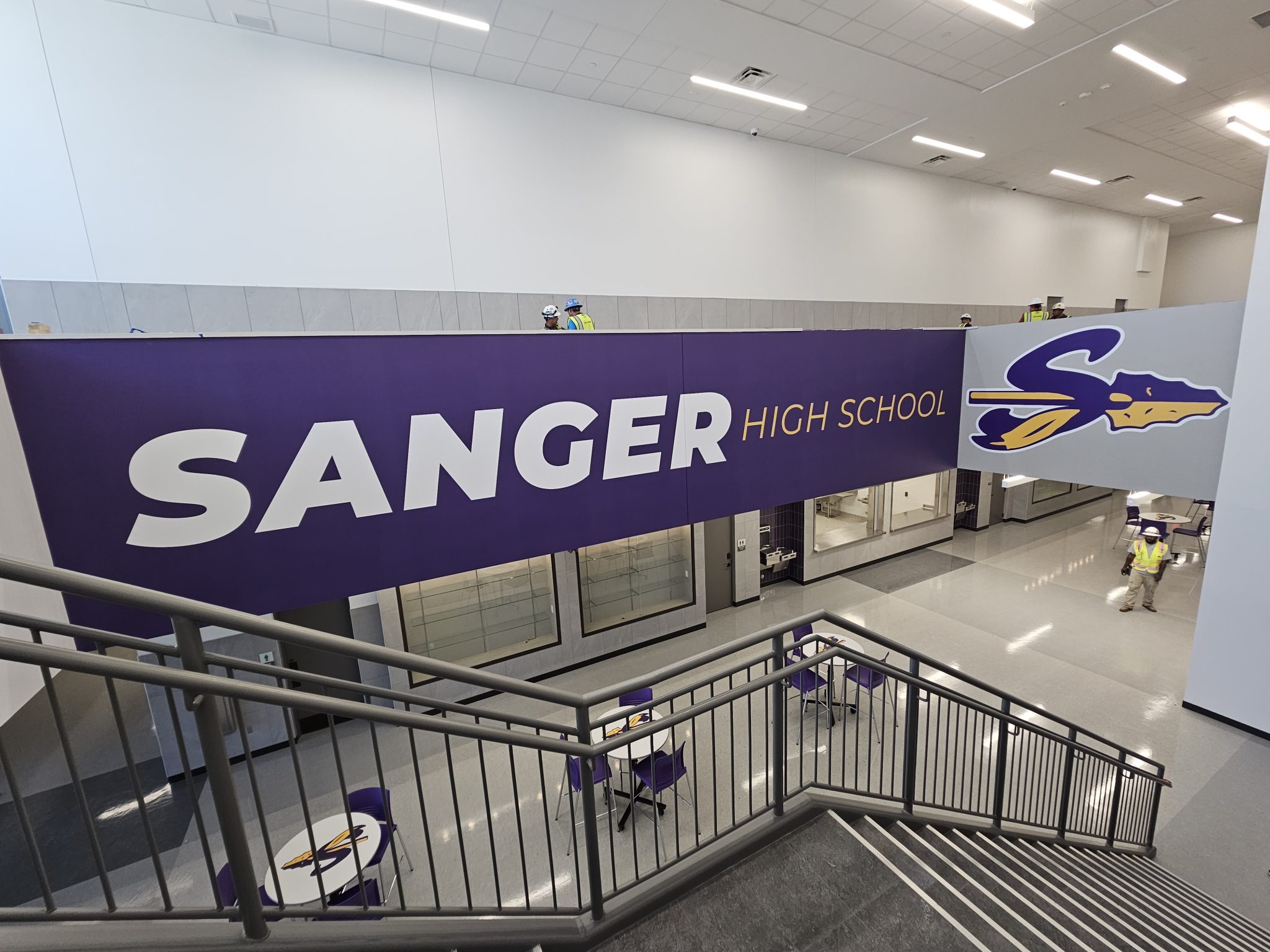
Environmental Graphics in K–12 and Higher Education
MAY 20, 2026| SpeedPro IrvingCategories
Environmental GraphicsEnvironmental graphics on K–12 and higher education projects sit at the intersection of brand, code, and construction schedule, and they often land on the architect or project manager’s plate late, when the schedule is tightest. Districts want a finished campus that reflects their identity. Universities want donor and recruitment moments built into the architecture. Both expect ADA compliance, durable materials, and an installation that doesn’t disrupt classes or campus events.
Most of that pressure flows back to the design and construction team. You’re coordinating a signage package alongside a GC, negotiating brand standards with a district marketing office, specifying substrates that will survive a high school gym or a first-year residence hall, and protecting a summer install window that can’t slip. A graphics partner who understands those constraints and can work from your drawings, your brand standards, and your schedule saves time at every phase from design development through punch list.
Environmental graphics are one tool the design team controls to deliver on those goals. This guide covers how they fit into K–12 and higher education projects from the AEC side: what to spec, what to coordinate, where ADA and procurement realities tend to bite, and how to scope a graphics partner so the install lands on schedule. Wall murals, wayfinding signage, ADA signs, donor displays, and outdoor graphics round out the toolkit that the design team specifies and coordinates.
What Educational Clients Are Asking Design Teams to Solve
Districts and universities arrive at the design table with a mix of pedagogical, branding, and operational goals, and they expect the graphics package to carry several of them at once. Understanding what’s actually on the client’s scorecard helps the design team scope the work accurately from the start.
Recruitment and enrollment pressure: K–12 districts compete for enrollment within their region; universities compete nationally. Both expect the built environment to handle recruiting work, campus tours, open houses, and admissions events; these are weighed in the design brief, not just the marketing budget.
Donor and recognition programs: Higher ed projects often carry a parallel donor scope: naming opportunities, recognition walls, and named-space signage that have to be designed for change over a 20-year horizon.
Wayfinding across multi-building campuses: Large K–12 campuses and university systems need a consistent wayfinding that works across renovations and new construction. This is where a signage package overlaps with the architectural program.
Identity and brand consistency: Districts with multiple campuses and universities with multiple colleges expect graphics that reinforce a single brand across buildings designed in different decades by different firms.
Knowing which of these the client is actually buying and in what priority shapes downstream substrate, scope, and budget decisions.
How K–12 Schools Use Environmental Graphics
In K–12, environmental graphics do their heaviest lifting around student experience and school pride. The audience is the students who walk those hallways every day, and the parents deciding whether to enroll. Bright wall murals and reading themes shape how younger kids feel about the building, while older students respond to graphics that celebrate athletics, achievement, and the programs that connect classroom work to life after graduation.
Athletics-Focused Graphic Displays
Gym graphics, locker room murals, championship displays, and sponsor signage help create a more polished athletic environment. These spaces often become a major source of school pride.
Career and Technical Education Areas
Many districts now highlight CTE programs with custom graphics tied to healthcare, engineering, culinary arts, or skilled trades. These visuals help students connect programs to future careers.
Hallway and Common Area Branding
Mission statements, mascots, school colors, and student achievement walls help campuses feel more unified. They also give schools opportunities to celebrate their students in visible ways.
Environmental Graphics on College Campuses
Higher ed uses environmental graphics for a different job. Universities are competing for tuition dollars and philanthropic gifts, and the spaces themselves are part of that pitch. A single campus may be hosting a prospective family tour in one building, an alum reception in another, and a board meeting with major donors down the hall , all in the same afternoon. Graphics carry the institution’s brand through each of those moments and create the surfaces where recognition, recruitment, and retention happen.
Many colleges use environmental graphics for:
Student Recruitment
Campus tours are competitive. Schools want facilities to feel current, organized, and connected to student life. Large-format graphics can help showcase campus culture, academic programs, and school traditions.
Donor Recognition
Donor walls and recognition displays are common in performing arts centers, athletic facilities, libraries, and academic buildings. These installations often become long-term parts of the campus environment.
Residence Halls and Student Spaces
Universities have been placing greater emphasis on the student experience over the last several years. Graphics inside residence halls, student unions, and collaboration spaces can make those areas feel more inviting.
Popular Environmental Graphic Solutions for Schools
Most schools use several types of graphics across campus rather than relying on a single product.
Interior Graphics
Interior graphics help shape the space’s feel.
Common options include:
- Wall murals
- Window graphics
- Dimensional lettering
- Floor graphics
- Department branding
Libraries, cafeterias, media centers, and student commons are popular locations for these installations.
Exterior Graphics
Exterior graphics usually focus on visibility and navigation.
Schools often install:
- Building identification signs
- Stadium graphics
- Fence mesh graphics
- Campus maps
- Entrance signage
Districts with multiple campuses also use exterior graphics to maintain consistent branding from location to location.
ADA Signage
ADA signage is one of the most important pieces of a campus signage system. Schools need signs that meet accessibility requirements while still fitting the building’s overall look. Requirements may include:
- Raised lettering or Braille
- Placement restrictions (such as height above floor)
- Color contrast demands
- Mandated signage for bathrooms and wheelchair/mobility aid exits
Temporary Graphics
Schools host numerous events throughout the year, making temporary graphics useful in both K–12 and higher education.
These often include:
- Graduation signage
- Event graphics
- Open house displays
- Athletic tournament graphics
- Fundraising campaign signage
Temporary graphics give schools flexibility without the need for permanent renovations.
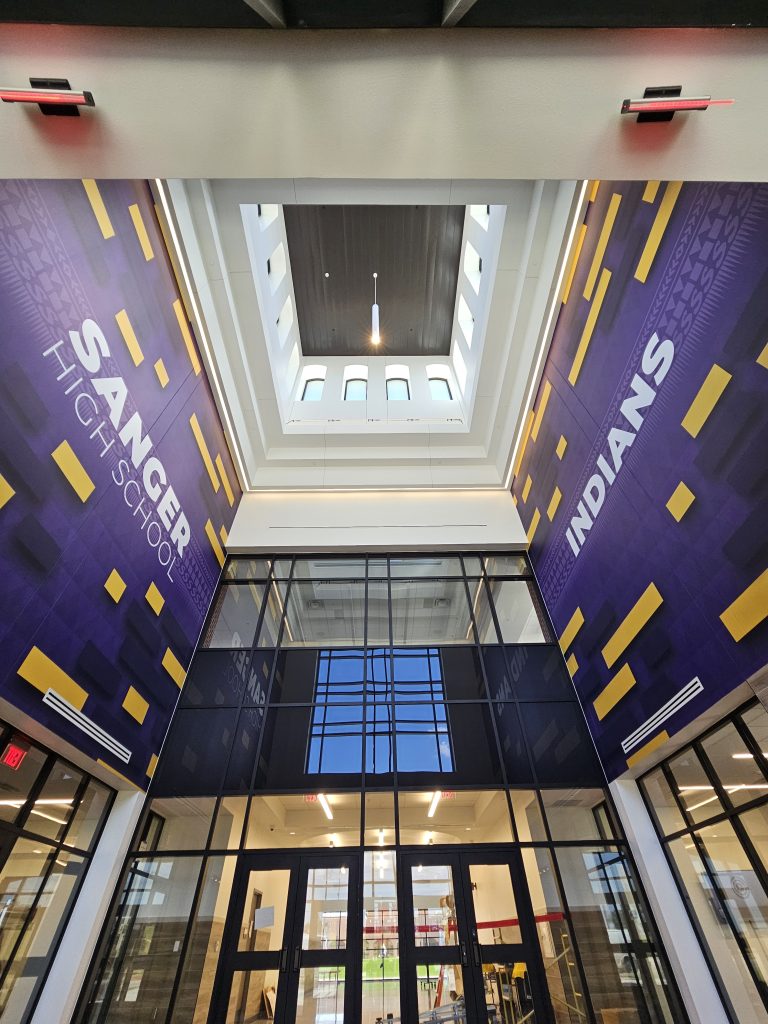
Specification and Coordination: What Design Teams Should Build Into the Scope
This is where most educational graphics projects succeed or fail. The design team’s choices regarding substrate, schedule, code workflow, and stakeholder coordination determine whether the install stays within budget and meets the academic calendar.
Substrate selection by location
Different campus environments demand different material specifications, and a single project usually mixes several:
- High-humidity locations (locker rooms, natatoriums, food service) require non-porous substrates with sealed edges; standard wall vinyl will fail within a year.
- High-impact corridors and gyms need abrasion-resistant materials, typically heavier-gauge vinyl with a protective laminate, or dimensional materials like phenolic and aluminum composite for areas below 8 feet.
- Exterior applications (building ID, stadium graphics, fence mesh) require UV-stable inks and substrates rated for the local climate; Texas exterior installations require different specs than those in the Pacific Northwest.
- Dimensional and ADA signage in classroom corridors typically uses acid-etched or photopolymer construction for durability and tactile compliance.
Getting substrate selection into the design package early, rather than as a value-engineering exercise late, avoids the common scenario in which graphics are cut or downgraded to hit budget.
Installation timing and the academic calendar
For occupied campuses, the install window is usually a hard constraint, not a preference. Common windows:
- Summer break (early June through mid-August in most districts) for the majority of K–12 work
- Winter and spring breaks for smaller scopes or punch-list items
- Weekend and overnight installs for higher ed during active terms, with corresponding labor premiums
Building the graphics install sequence into the overall construction schedule and confirming substrate lead times against that window are among the most common coordination failures on these projects.
ADA compliance workflow
ADA signage is rarely just a product specification; it’s a workflow question. The design team should clarify upfront:
- Who owns ADA code review for the signage package: the architect, the signage vendor, or a third-party reviewer?
- Are raised characters and Braille produced via photopolymer, rotary engraving, or 3D printing, and does the chosen method meet the project’s durability requirement?
- How do mounting height (60-inch centerline to the baseline of the tactile characters), placement (latch side of the door), and finish (non-glare) get verified during install and punch?
- Is the project subject to state-specific accessibility requirements beyond ADA (California Title 24, Texas TAS) that may exceed federal minimums?
Brand standards integration
Most districts and universities have a brand standards document, sometimes a recent one from a rebrand, sometimes a 15-year-old PDF nobody enforces. The design team should confirm:
- Whether the graphics partner will work from existing standards or develop a signage-specific extension
- Approval workflow: who signs off on design (typically marketing or communications, not facilities)
How standards apply to non-standard substrates (a brand color specified for digital may not be achievable in dimensional letters)
Procurement and contracting realities
- Public K–12 and state university work often comes with procurement constraints that affect graphics scope.
- Prevailing wage and Davis-Bacon requirements on certain federally-funded projects
- District purchasing thresholds that may require competitive bids or cooperative purchasing contracts (TIPS, Sourcewell, BuyBoard)
- Bonding and insurance requirements, general liability minimums, payment, and performance bonds on larger scopes
Flowing these requirements into the graphics RFP and confirming the chosen vendor can meet them avoids late-stage scope rework.
How SpeedPro Irving Works With Design and Construction Teams
Most of the educational projects we deliver come through architects, signage consultants, general contractors, and project managers, not through districts directly. The workflow we’ve built reflects that.
Design assist and early specification
We can engage during design development to advise on substrate, mounting, and ADA approach, and to flag long-lead items before the spec is locked. For teams without an in-house signage specialist, this is often where the most value lands: a 30-minute call during DD can prevent a value-engineering round during CDs.
Submittals and shop drawings
On negotiated and bid work, we produce shop drawings, material samples, and color drawdowns sized to the project’s submittal process. We work from the architect’s signage schedule and elevations, or develop the schedule jointly when none exists yet.
Mock-ups
For high-visibility installations, donor walls, major wayfinding, and stadium graphics, we can produce mock-ups for client and design-team review before full production. This is particularly useful when brand color reproduction or substrate texture is in question.
Coordination with the construction schedule
We coordinate directly with the general contractor on site access, sequencing, and punch-list closeout. For occupied campuses, we plan around testing windows, athletic events, and academic calendars in addition to construction milestones.
Warranty, lifecycle, and replacement
Graphics in educational environments have a longer expected service life than retail or event work, typically 5–10 years for interior graphics, 3–7 years for exterior graphics, and longer for dimensional and ADA graphics. We provide written warranties scoped to the substrate and environment, and can maintain digital files and color specs for future replacement or campus-wide rollouts.
Working with SpeedPro Irving on your next education project
Whether you’re scoping a single building or a multi-campus district rollout, we can engage at any phase, design assist, bid, or build. We work with architects, signage consultants, GCs, and PMs on K–12 and higher education projects across the Dallas–Fort Worth metro and surrounding region.
Ready to discuss your project? Contact SpeedPro Irving to scope a graphics package that fits your design, schedule, and budget.
SpeedPro Irving works with schools, colleges, universities, architects, and contractors to produce large-format graphics built for educational environments. Projects may include wall murals, ADA signage, donor recognition displays, window graphics, and campus wayfinding systems.
Ready to upgrade your school or university’s environment? Contact SpeedPro Irving for a consultation today.